
When to Call a Pest Control Pro Instead of Doing It Yourself
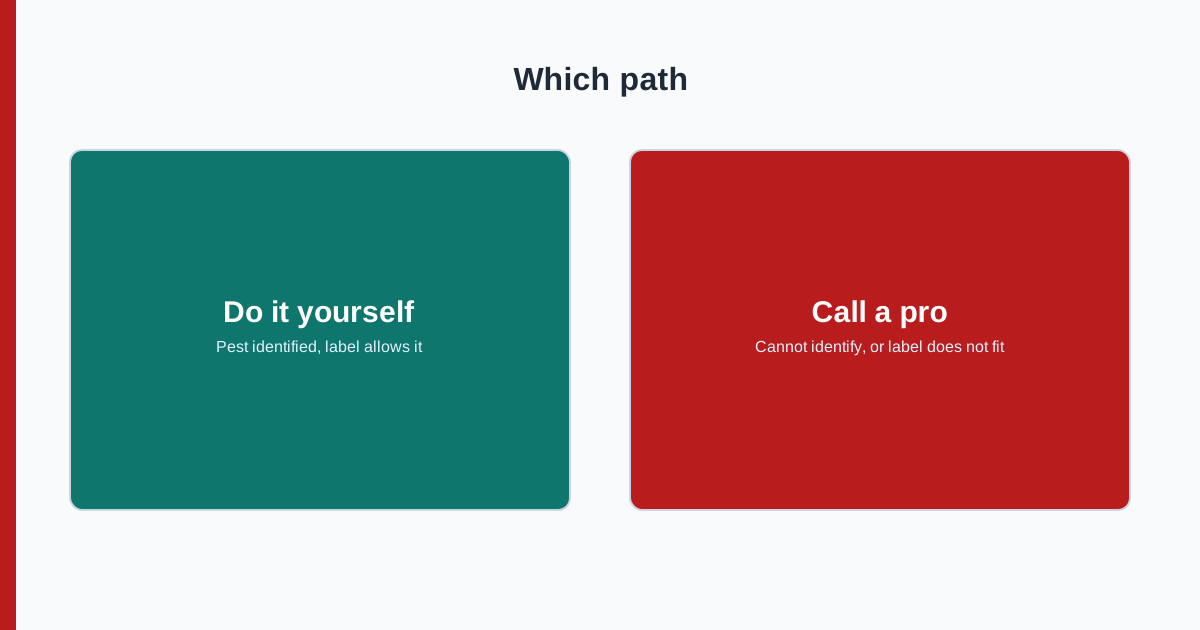
Call a pest control company when you cannot identify the pest, when the label on a store product does not match the problem, or when you do not want to handle pesticides yourself. Stay with do-it-yourself steps when you know what the pest is, you can remove what it needs, and any product you use is allowed by its label for that exact use. EPA's Citizen's Guide says using a pesticide in a way the label does not allow is illegal.
GetPestFixed connects you with independent providers. It does not treat homes, and it does not promise the pests will be gone. EPA says that for many pests, total elimination is almost impossible. The goal it describes is control, with the least hazard that will work.
Signs that a problem is already past a casual look are in when to call pest control. This page is the choice between doing the work and hiring it.
EPA's order of operations
EPA's guide gives four steps before you jump to a product:
- Identify the pest. Some signs are obvious, such as a cockroach or a mouse. Some are not. EPA's example: a plant that looks diseased may be short of water or in poor soil. County extension offices and state university sites are the free identification help the guide names.
- Decide how much control you actually need. EPA says demanding a pest-free house and yard leads to more chemical treatment than necessary. It asks whether you can tolerate some weeds or some insects, including beneficial ones.
- Choose a method. Prevention and non-chemical tools come before sprays. Traps, caulk, sealed food, and fixing leaks are in the guide's prevention section.
- Evaluate. Compare what you saw before and after. Look for fewer pests, not a forever promise.
Prevention details that match this site's checklist are in how to prevent household pests. EPA's own prevention list includes fixing leaks, storing food in sealed containers, caulking entry points, and keeping wood piles and mulch away from the house. The guide says to keep vegetation, shrubs, and wood mulch at least 18 inches from the house.
A practical split
| Situation | A reasonable next step | Why |
|---|---|---|
| You know the pest, and sanitation or a trap fits the label | Do that, and give it time. EPA says non-chemical methods can take longer. | You have identified the pest and you are not improvising a spray. |
| You would be guessing the pest | Stop and identify it, or hire someone who will inspect. | The wrong product is both ineffective and a label problem. |
| The only product you can find does not list your pest or your site | Do not use it there. | Off-label use is illegal. |
| Children, pets, or someone sensitive to chemicals share the space | Read pesticide safety around children and pets and the label's re-entry instructions. Hire if you cannot follow them. | EPA says one of the greatest sources of pesticide exposure is home use. |
| The problem is in the structure, such as termites, or it keeps returning after you removed food and water | Get a written inspection and a plan. | Repeating store sprays is the pattern EPA ties to resistance and extra hazard. |
| You want someone else to apply the product | Hire a licensed company and read the estimate against the label. | How to read both is in the estimate and label guide. |
If the pest is bed bugs, the rooms, the clutter, and whether neighboring units are involved change the quote. Those factors are in what changes a bed bug treatment quote.
If you do buy a product, EPA says to pick the least toxic one that will do the job, to read the signal word (Danger, Warning, or Caution), and to remember that an EPA registration number is not a guarantee the product will work.
What hiring does not remove
You still identify your concerns: allergies, infants, older adults, pets, wildlife. EPA says those belong in the contract. You still compare two or three bids on value, not only price. How to line those bids up is in how to compare pest control quotes. You still watch results after the visit, which is described in what to expect during a pest control visit.
If exposure causes unconsciousness, trouble breathing, or convulsions, call 911. Otherwise EPA says to call the poison center at 1-800-222-1222 with the label available. The National Pesticide Information Center is 1-800-858-7378.
A referral request can start at the GetPestFixed homepage or at +1 (833) 694-1155. Ask the company that contacts you for its license and verify it with your state pesticide agency. This phone number is not a promise that a specific technician will arrive the same day.
Questions people still ask
Is DIY always safer because I use less product?
No. EPA says home pesticides can be hazardous when they are stored, handled, applied, or thrown away incorrectly, and that no special training is required to buy them. A small amount used against the label can be the dangerous amount.
Should I call at the first ant?
Not always. EPA says pest control is not pest elimination, and that seeing a pest is the moment to identify it and remove food, water, and entry points. Call when those steps are not enough or you cannot tell what you are looking at.
Will a professional guarantee the pests are gone forever?
Be skeptical if the contract says that without conditions. EPA says to read what you must do to keep a guarantee, and that total elimination is not a realistic goal for many pests.
GetPestFixed is a Ridge Rise Media property.