
Small Black Bugs in the House: An ID Guide for Small Flying Bugs
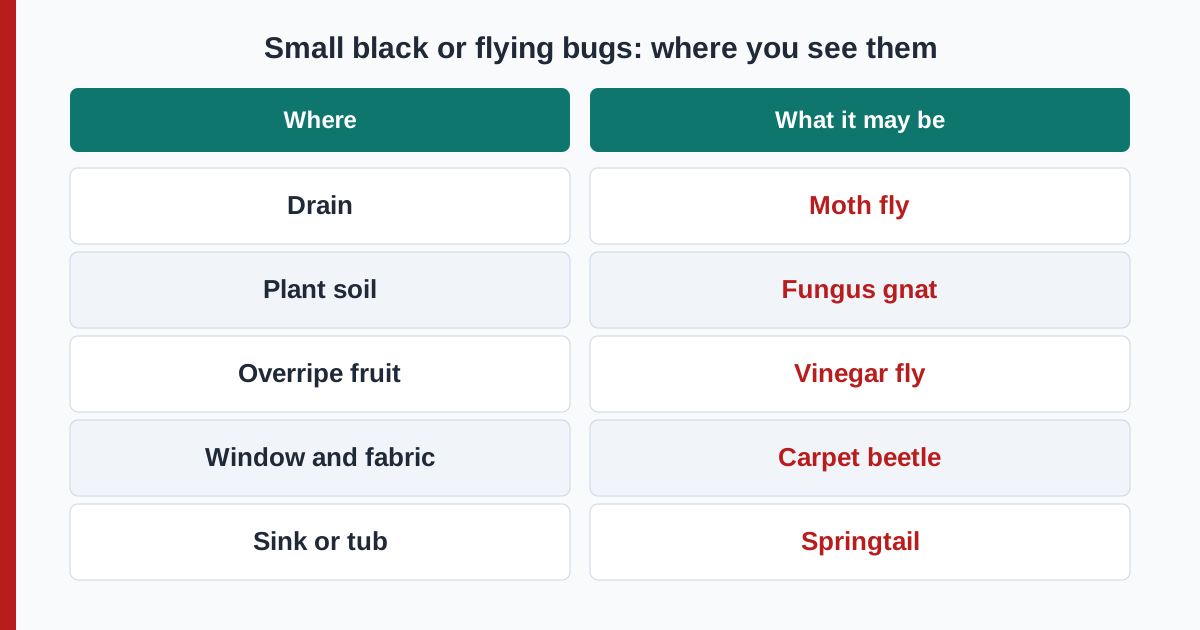
Small flying bugs in the house, and little black bugs in the house, are not one pest. Small black bugs in the home, including what people call tiny black bugs, can be a moth fly, a fungus gnat, a springtail, or a carpet beetle. A small flying bug near fruit is often a vinegar fly, and those adults are brown to yellow with red eyes, not black. This page is an identification guide. It does not tell you how to get rid of cockroaches, ants, or mice.
GetPestFixed does not identify insects in your kitchen and does not apply products. If the insect is coming out of a sink or shower, use bugs in the drain or shower, which is the drain-specific check. The hiring decision is in when to call a pest pro instead of doing it yourself.
Match the place, then the insect
| Where you keep seeing it | Closest match | The mark the source tells you to use |
|---|---|---|
| On the wall beside a sink, tub, or floor drain | Moth fly (drain fly) | UC IPM: about 1/8 inch, dark, wings held roof-like, covered with fine hairs, weak hopping flight. Clemson Extension: 1/16 to 1/4 inch, hairy, yellow to brown to black. They do not bite. |
| On potting soil, or flying weakly near a houseplant or a window | Fungus gnat | UC IPM: commonly 1/16 to 1/8 inch, dark, slender, antennae longer than the head. Adults do not bite. Larvae live in moist organic matter and can chew roots. |
| On or above overripe, damaged, or fermenting fruit | Vinegar fly (a drosophilid fruit fly) | UC IPM: adults 1/12 to 1/8 inch, brown to yellowish, red eyes, clear wings on most species. Larvae of the common vinegar fly feed in damaged or fermenting fruit. |
| On a sunny windowsill, with damage to wool, fur, feathers, or stored food | Carpet beetle | UC IPM: adults about 1/10 to 1/8 inch, round bodies, short antennae, color from black to a mix of white, brown, and yellow. Older adults can look solid black after the colored scales wear off. Adults do not eat fabric. The larvae do. |
| In a sink, bathtub, or damp basement, and it jumps | Springtail | UC IPM (updated August 2025): about 1/16 inch, wingless, whitish to black, jumps several inches. Does not bite, does not spread disease, and does not damage furnishings. Jumping is why people mistake them for fleas. |
A half-inch black insect with red or orange lines is outside this table. That pattern is a boxelder bug, covered in where boxelder bugs come from. A trail of insects between a crack and a food spill is the ant problem, covered in how to get rid of ants in the house. Specks that hide in cracks by day and show fecal smears, cast skins, or egg cases are the cockroach problem, covered in how to get rid of cockroaches. Do not use this page as a rewrite of either treatment.
What each clue is telling you
The drain. Moth flies develop in the slimy film in drains and sewers. University of Maryland Extension says they are 1/16 to 1/4 inch, fuzzy, and pale brownish-gray to black, and that fungus gnats can breed in drains too. If both could fit, the antennae and the plant pot are the split: a fungus gnat's antennae are longer than its head, and UC IPM says the flies stay near the potting mix. The drain article has the cup test and the cleaning disagreement. This page stops at the name.
The plant. Fungus gnat adults are a nuisance. UC IPM says they do not bite and do not damage plants themselves. The larvae, in large numbers in wet, organic soil, can chew roots. The same note says insecticides are rarely warranted for these flies in and around a home, and that the useful step is to stop overwatering and let the surface of the potting mix dry. Yellow sticky traps and a raw potato chunk, cut side down, are the monitoring tools it describes. Those are checks, not a promise the pot will recover. A wilted plant is more often water, drainage, or root decay than gnats.
The fruit. UC IPM separates two insects that share the name fruit fly. The vinegar fly in a kitchen is the small one with red eyes, breeding in fruit that is already damaged or fermenting. The larger tephritid fruit flies are agricultural pests, about 1/4 inch, with wing markings. UC IPM, writing for California, says to take a tephritid fly or a maggot found in fruit or nuts to the county agricultural commissioner unless you are confident that species is already established there. A red-eyed fly on a banana is the vinegar fly, not that report. Removing the overripe fruit is the sanitation step the note names. This page does not add a spray schedule.
The window and the fabric. Carpet beetle adults fly in from flowers or ride in on cut flowers, and UC IPM says that indoors they show up near windows because they are attracted to sunlight. Finding the adult on the sill does not mean the adult is eating the curtain. The larvae feed on animal products such as wool, leather, silk, fur, and feathers, and on stored food. The black carpet beetle adult is shiny black to dark brown and about 1/8 to 3/16 inch. Varied and furniture carpet beetles are smaller and patterned until the scales wear off, when they can look solid black. If you have the adult and no fabric or food damage, you may only be seeing a pollen feeder that came inside. If you have larvae or damaged wool, you have moved past identification, and this guide does not substitute for a fabric-treatment plan.
The jump in the sink. Springtails live in damp soil, mulch, and leaf litter and come inside when it dries outdoors, or they ride in on a pot. UC IPM says that after they enter they look for moisture and often end up trapped in sinks and tubs, and that they die indoors unless moisture remains. The management note says to dry the area, fix leaks, and avoid overwatering pots. It also says not to pour or spray insecticides down the drain. Washing the insects down the drain is the step it gives for the ones already in the sink.
When the name is still wrong
EPA's Citizen's Guide puts identification before any product, and it points to county extension offices when you cannot tell. Use that stop if the insect fits none of the rows. A sticky trap kept for someone else to look at is more useful than a fogger aimed at "tiny black bugs," which is not a species.
Hire, or ask extension, when:
- You have matched the place and the insect still does not fit a row.
- The same insect keeps appearing after the moisture, the fruit, or the film it needs is gone.
- You would be guessing a product. Off-label use is the line EPA says not to cross.
- The breeding site is inside a wall or under a slab. That case is described for moth flies in the drain article.
A referral can start at the GetPestFixed homepage or at +1 (833) 694-1155. Confirm any company's license with your state pesticide agency. The call is not a promise of a same-day visit.
The publisher that operates GetPestFixed describes that referral work on its pest-control vertical.
A different question is covered in How to Reduce Mosquitoes Around the House.
GetPestFixed is a Ridge Rise Media property.
Sources
- UC IPM: Moth or Drain Flies, updated March 2014
- Clemson Cooperative Extension, HGIC 2436: Moth Flies (Drain Flies), revised June 17, 2026
- University of Maryland Extension: Drain Flies, updated October 17, 2024
- UC IPM: Fungus Gnats, updated August 2013
- UC IPM: Fruit Flies
- UC IPM: Carpet Beetles, updated April 2020
- UC IPM: Springtails, updated August 2025
- EPA: Citizen's Guide to Pest Control and Pesticide Safety (PDF)