
Bugs in the Drain or Shower: What They Are and When to Call
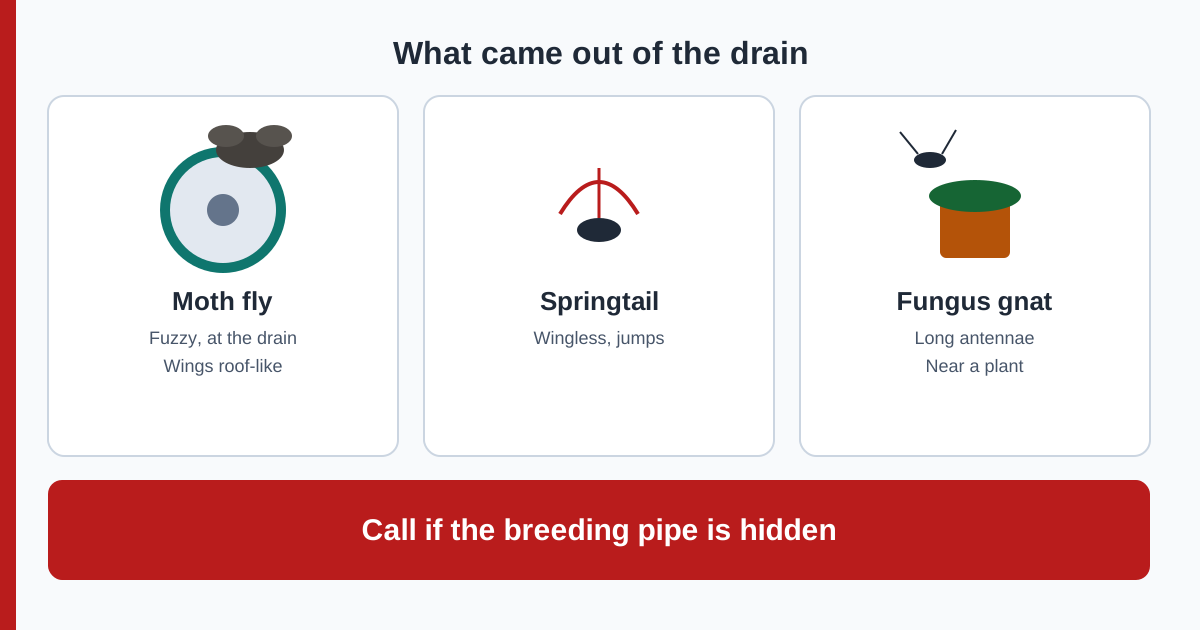
Bugs that come out of drains are usually breeding in that drain. Sink drain bugs, and bugs in a shower drain, are often moth flies, also called drain flies, living on the gelatinous film inside the pipe. A bug in the drain can also be a springtail or a fungus gnat. The first job is to tell which one you have. Spraying the adult on the tile does not remove the film the larvae are eating.
GetPestFixed does not clean pipes or treat bathrooms. It connects you with independent providers and does not promise the insects will be gone. The choice between doing the work and hiring it is in when to call a pest pro instead of doing it yourself. Repeated sightings of any pest are in when to call pest control. Moisture, food, and sealing are in how to prevent household pests.
Match the insect before you treat the drain
| What you see | What it may be | What the extension source uses to separate it |
|---|---|---|
| Small, fuzzy, moth-like fly resting near a sink or shower, wings held roof-like | Moth fly, also called a drain fly | Clemson Extension (revised June 17, 2026) gives adults as 1/16 to 1/4 inch, hairy, yellow to brown to black. UC IPM describes a typical adult as about 1/8 inch, dark, and a weak flyer that takes short hops. They do not bite. |
| Tiny wingless speck in the sink, tub, or on the floor that jumps when you get close | Springtail | UC IPM (updated August 2025) says springtails are about 1/16 inch, wingless, whitish to dark gray or black, and jump with a tail-like mechanism. They do not bite. People confuse them with fleas because they jump. |
| Dark, delicate fly with long antennae, often on or near a houseplant, sometimes also at a drain | Fungus gnat | UC IPM says adults are commonly 1/16 to 1/8 inch, dark, with antennae longer than the head. University of Maryland Extension says fungus gnats can also breed in drains. |
| Several of these in a room, and you still cannot tell | Stop and identify | EPA's Citizen's Guide says identification is the first step. County extension offices and state university sites are the free help it names. |
Clemson says most moth-fly infestations start in the building where you see the adults. The larvae feed on decaying material in the film. University of Maryland Extension adds other breeding spots: sewer leaks and backups, dirty garbage cans, saucers under potted plants, clogged storm drains, and condensate pans under refrigerators and air conditioners. A fly in the bathroom is a reason to check those spots, not only the shower drain.
A one-night check on which drain it is
UC IPM's moth-fly note says adults are weak flyers, so they are often near the pipe they came from. Its check: coat the inside of a cup or jar with petroleum jelly or vegetable oil, invert it over the drain, and leave it for 24 hours. Flies emerging from that pipe stick to the coating. Do this on every drain in the room. If the cup stays empty and you still see adults, the breeding film may be deeper in the pipe, or in a leak you cannot see. Clemson and Maryland both say the larvae live in that film and are seldom the stage you notice.
Cleaning, where the extensions do not all agree
The shared point is that the film has to go. The method is not identical in every note.
University of California's moth-fly note calls pouring boiling water or bleach down the drain a misconception. Those treatments do not remove the organic film, and any drop in flies is short. It says to use a hard-bristle brush with a drain cleaner made for that job, to snake a slow drain, and, on a sink with a trap underneath, to remove the trap and clear the debris. Afterward, run water and confirm the drain flows.
Clemson Extension says drains can often be cleaned with an over-the-counter cleaner followed by very hot water, and that a stiff brush is the next step if that film is still there. University of Maryland Extension says to clean traps and drains mechanically or with an over-the-counter drain cleaner followed by hot water, and to clean or eliminate the other breeding sites.
Read those as a sequence you can check, not as three products to mix. If a brush and a free-flowing drain do not stop new adults, you have not yet found the film. Killing the fly on the wall is the step Clemson separates from long-term control: an aerosol can kill the adult you see, and the breeding site still has to be removed. Any product you do use has to match its label. How to read a label is in how to read a pest control estimate and a pesticide label. If children or pets use the room, read pesticide safety around children and pets before a product is opened. UC IPM says insecticide use against moth flies in a home is generally unnecessary when the film can be cleaned.
When to call
Use this list before you hire. It is the point where a brush and a cup test stop being enough.
- The cup test is positive on a drain, you have scrubbed the film you can reach, and new adults are still emerging a life cycle later. Clemson says a moth-fly life cycle can finish in as little as two weeks. UC IPM says the cycle can be as short as 8 days or as long as 24, depending on temperature. Maryland says egg to adult may take 7 to 28 days, and that adults may live up to two weeks. Give the cleaning that window before you decide it failed.
- You cannot reach the film. UC IPM says development sites inside a wall void or under a slab are a reason to contact a professional.
- The drain is slow, smells, or you suspect a broken pipe. Clemson says difficult moth-fly control can mean broken pipes or moisture problems you cannot find or repair, and that a pest control operator or a plumber is the person to consult.
- You cannot tell the insect from a cockroach, an ant, or something else. Identification comes first. Cockroach control is a different article, how to get rid of cockroaches. Ants are in how to get rid of ants in the house.
- You do not want to handle a pesticide. That choice is the hiring page linked above.
Clemson says to get quotes from two or three firms and to understand the contract before you hire. A referral can start at the GetPestFixed homepage or at +1 (833) 694-1155. Ask the company that contacts you for its license and confirm that license with your state pesticide agency. The phone number is not a promise that someone will arrive the same day.
Who operates this site is described on the publisher's pest-control vertical and about page.
A different question is covered in Brown Marmorated Stink Bugs: What They Do Not Damage.
GetPestFixed is a Ridge Rise Media property.
Sources
- Clemson Cooperative Extension, HGIC 2436: Moth Flies (Drain Flies), revised June 17, 2026
- University of Maryland Extension: Drain Flies, updated October 17, 2024
- UC IPM: Moth or Drain Flies, updated March 2014
- UC IPM: Springtails, updated August 2025
- UC IPM: Fungus Gnats, updated August 2013
- EPA: Citizen's Guide to Pest Control and Pesticide Safety (PDF)